We ranked the best plumbing company websites on design, speed, and conversion power. See which sites made our list and what makes them work harder than the competition.
A plumber who can't be found online is a lot like a pipe with no connection: full of potential and completely useless to the person who needs it most. The plumbing industry in the United States is one of the most essential and consistently in-demand trades in existence, generating over $130 billion in annual revenue and employing more than 560,000 licensed plumbers across the country. Despite that scale, a staggering number of plumbing companies continue to operate with websites that would have felt outdated a decade ago, leaving serious money on the table in a market where digital search has become the primary way homeowners and property managers find service providers. The companies that have figured out the connection between a great website and a full schedule are running laps around those who haven't.
What makes plumbing such an interesting industry from a digital marketing perspective is the nature of the buying decision itself. A significant portion of plumbing calls are emergency-driven, meaning a homeowner with a burst pipe or a backed-up sewer line is not leisurely comparing five companies over the course of a week. They are making a fast, high-stress decision based almost entirely on what they find in the first 30 seconds of a search. That urgency makes first impressions worth more in plumbing than in almost any other home service category. According to the Plumbing-Heating-Cooling Contractors Association, the demand for qualified plumbing contractors continues to outpace supply in most U.S. markets, which means companies with strong digital visibility are capturing a disproportionate share of available work simply by being easier to find and easier to trust online.
At Elite Web Design, we put together this evaluation by reviewing plumbing company websites across the country through a detailed lens that goes well beyond aesthetics. We scored each site on page load speed, mobile responsiveness, messaging clarity, trust signal placement, local SEO structure, call-to-action effectiveness, and overall conversion architecture. We were not looking for the prettiest homepage or the most animated design. We were looking for websites that understand the plumbing customer, meet them where they are emotionally, and make it as frictionless as possible to take the next step. The companies featured below earned their spots on this list by excelling across every one of those categories, and one of them rose clearly above the rest.
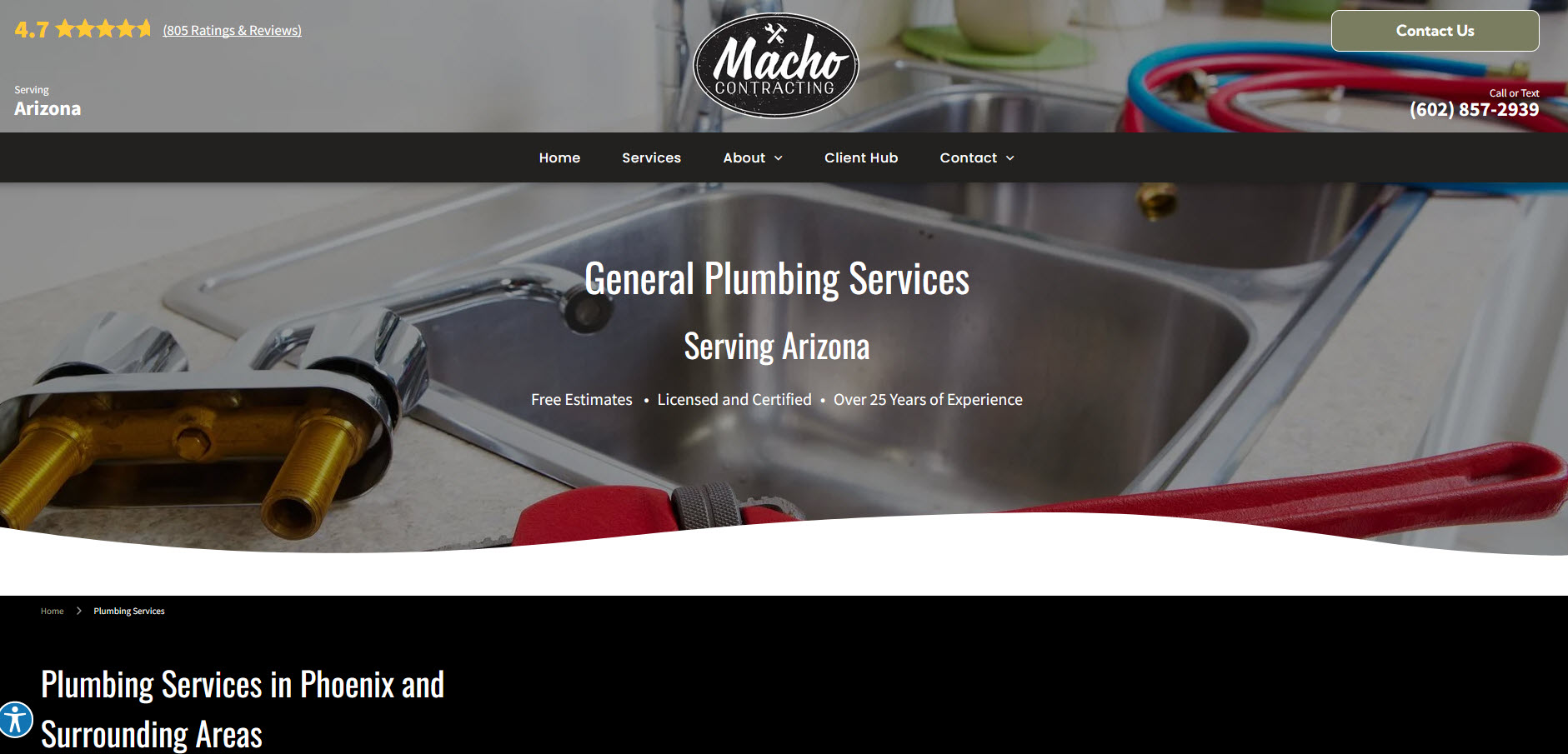
There are plumbing websites that look professional, and then there are plumbing websites that feel like they were built by people who actually understand what it takes to win a job online. Macho Contracting's plumbing services page falls firmly into the second category, and the difference is immediately apparent from the moment you land on the page.
The layout is clean, purposeful, and structured in a way that guides the visitor through exactly the information they need to feel confident making a call. The messaging communicates reliability and professionalism without resorting to the tired clichés that clutter most trade service websites. Trust signals are positioned strategically rather than dumped into a sidebar nobody reads, and the calls to action are clear, direct, and repeated at the right intervals throughout the page. The mobile experience is seamless, which matters enormously for a service category where emergency searches happen in stressful moments on a phone screen. This is a page that earns its ranking not through flashy design tricks but through smart, customer-focused architecture that converts visitors into booked jobs. It leads our list for good reason.
Roto-Rooter is one of the most recognized names in the plumbing industry, and their website reflects the kind of investment that brand recognition can support. The homepage is structured around urgency, with 24/7 availability messaging front and center and a service booking tool that removes as much friction as possible from the process. Their location pages are well-built and consistent across markets, which is a significant technical achievement for a company operating at national scale. The overall design communicates dependability, which is exactly the right emotional note for a service that people call when things go wrong.

Mr. Rooter has built a franchise-wide digital presence that manages to feel local even while operating across hundreds of markets. Their website leads with upfront pricing messaging, which is one of the most powerful trust signals in the trades because it directly addresses the anxiety most homeowners feel about calling a plumber. The service pages are detailed and genuinely helpful, which supports both customer confidence and search engine visibility. Navigation is intuitive, the brand voice is warm without being unprofessional, and the overall site performs consistently well on mobile devices.
Benjamin Franklin Plumbing has built their entire brand around the concept of punctuality, and their website hammers that message home at every turn. The "If There's a Delay, It's You We Pay" positioning is front and center in the digital experience and it works because it directly addresses one of the biggest complaints homeowners have about tradespeople. The site is clean, fast, and well-organized, with strong calls to action and a consistent brand identity that carries through from the homepage all the way to individual service pages. For a company competing in the trust-sensitive world of home plumbing services, they've made all the right digital decisions.
Len The Plumber operates in the Mid-Atlantic region and has built a website that punches well above its weight for a regional brand. The homepage is visually strong, with high-quality photography that humanizes the brand in a way that most plumbing websites don't bother attempting. Their emergency plumbing messaging is prominent and well-executed, which is smart positioning for a market where after-hours calls represent a significant share of revenue. Customer reviews are integrated throughout the site in a way that builds credibility organically, and the service area pages are well-structured for local search performance.
ARS Rescue Rooter covers plumbing as part of a broader home services offering, and their website handles that complexity more gracefully than most multi-service companies manage. The navigation is clear enough that a visitor looking specifically for plumbing help can find what they need without wading through unrelated services. The homepage leads with a strong value proposition around licensed professionals and same-day service availability, and the site backs that up with detailed service pages that give homeowners real information rather than filler content. Their financing options are prominently displayed, which is a smart conversion tool for larger plumbing jobs like repiping or water heater replacement.
In a service category where a significant percentage of searches happen during an active emergency, a slow-loading website is not just a minor inconvenience. It is a direct revenue problem. A homeowner with water pouring through their ceiling is not waiting for a hero image to finish loading. They are clicking to the next result before your site has even introduced itself. Keeping page load times under three seconds requires a combination of properly compressed images, efficient code, reliable hosting infrastructure, and browser caching that serves your site fast to repeat visitors. Every second shaved off your load time translates directly into a higher percentage of visitors who stay long enough to become customers.
The plumbing industry sees some of the highest rates of mobile search of any home service category, driven by the emergency nature of many calls and the fact that problems tend to reveal themselves at inconvenient times when people are far from a desktop computer. A plumbing website that isn't optimized for mobile isn't just behind the curve. It is actively costing the business jobs. True mobile optimization means more than a responsive layout. It means:
Getting this right isn't optional for a plumbing company competing in any market larger than a small town.
Ranking well in local search results is the single most impactful thing a plumbing company can do for long-term digital growth. For most plumbing searches, Google's local pack, the three business listings that appear above organic results, captures the lion's share of clicks, which means your Google Business Profile needs to be fully optimized, actively maintained, and backed by a website that signals strong local relevance.
On the website side, that means having individual service area pages for every city and neighborhood you serve, using location-specific language naturally throughout your content, earning and displaying genuine customer reviews, and building out your site's technical structure so search engines can understand exactly who you are and where you work.
Beyond traditional SEO, answer engine optimization is becoming increasingly important as AI-powered search tools change how people find local services. Structuring your content to directly answer the questions plumbing customers ask, things like how much it costs to replace a water heater, what causes low water pressure, or how to tell if you need repiping, positions your site to appear in AI-generated search summaries that are now appearing above traditional results for many queries.
Most plumbing website copy is written from the company's perspective rather than the customer's, which is a fundamental mistake in a category where the buyer is almost always anxious, rushed, or frustrated. Effective plumbing website messaging leads with the outcome the customer wants: fast response, trustworthy technicians, upfront pricing, and a problem that gets fixed right the first time. Headlines that speak to those desires outperform clever taglines every time. Copy that acknowledges the stress of a plumbing emergency and immediately communicates that your company is calm, competent, and ready to help does more selling in two sentences than a full page of feature lists.
Homeowners hiring a plumber are letting a stranger into their home, often during a stressful situation, and handing over payment for work they can't fully evaluate themselves. That dynamic makes trust the most important factor in the buying decision, and a great plumbing website builds it proactively through:
When these elements are present and well-executed, a visitor who was mildly skeptical when they arrived leaves the page feeling genuinely confident, and confident visitors become booked jobs.
The gap between generating a lead and closing a job often comes down to how quickly and consistently a company follows up, and that is exactly what a CRM integration solves. When a homeowner submits a contact form on your plumbing website and that inquiry flows automatically into a CRM like HubSpot, ServiceTitan, or Housecall Pro, the entire follow-up process becomes faster, more organized, and more effective.
The practical benefits stack up quickly. Leads get assigned to the right person instantly rather than sitting in a shared inbox waiting for someone to notice. Automated follow-up sequences reach out to the homeowner within minutes, which research consistently shows produces dramatically higher response rates than follow-ups that happen hours later. Every interaction gets logged in one place, giving the team full visibility into where each lead stands without relying on memory or scattered notes. And over time, the data your CRM collects tells you which pages, keywords, and campaigns are generating your best leads, allowing you to invest your marketing dollars with much greater precision.
For a plumbing company where a single water heater replacement or repiping job can generate $3,000 to $10,000 in revenue, losing a lead because nobody followed up fast enough is an expensive failure that a connected system prevents automatically.
A plumbing website that looks polished on the homepage but falls apart on service pages or city landing pages sends a subtle but damaging signal to potential customers. Inconsistency in fonts, colors, image quality, and tone of voice makes a company feel smaller and less established than it actually is, and in a field where credibility is everything, that perception costs jobs. Maintaining a consistent visual identity and brand voice across every page of the site requires upfront planning but pays off continuously in the form of visitors who feel more confident the longer they spend on the site rather than less.
The plumbing companies featured in this article didn't make this list by accident. They made it because someone made a deliberate decision to treat their website as a revenue-generating tool rather than a digital placeholder, and then backed that decision up with real investment in speed, design, messaging, and conversion strategy. The result is a digital presence that works around the clock, capturing leads during emergencies, building trust with homeowners in research mode, and consistently outperforming competitors whose websites haven't been seriously updated in years.
The plumbing industry is not slowing down, and neither is the homeowner's expectation of finding a trustworthy company quickly and easily online. Every day that passes with a slow, outdated, or poorly converting website is a day that leads are going to whoever showed up better prepared. So the real question isn't whether your plumbing website needs work. The question is how many jobs have already gone to a competitor because yours wasn't ready when a homeowner needed someone right now?
